
Are you fit enough for good health?
Fit is not the same as healthy
Now don’t go thinking that you can give up on your exercise regime, because fitness is a key component for good health.
When I say “fit is not the same as healthy”, let’s look at what “healthy” means. What do you think of when I say “are you healthy? Chances are, you and I have different thoughts on this, depending on gender, age, stage of life, cultural background, economic status… I think you get the idea.
What does “health/healthy” mean?
- weight? Low or high?
- muscles?
- lack of disease?
- emotional health?
- mental health?
“Healthy” can mean different things to different people.
Health at different ages and stages
Health may be the absence of disease. But it can also relate to a person’s ability to perform everyday functions like carrying groceries, playing sport or doing a physical job.
Yet another person may consider “health” as being slim with clear skin and shiny hair, and someone else would talk about their mental health. Conversely, in some cultures, being overweight is an indicator of wealth and is more desirable.
So you can see, that different people have different ideas of what healthy means.
What does healthy mean to you? And what do you do to help you achieve that version?
Health as physical fitness
What does this mean?
In early adulthood physical fitness is often about appearance, weight and shape as well as being able to take part in events.
Once people, reach their 30s and 40s, life gets busier as they progress along the career ladder and maybe start families. At this stage of life, physical fitness can help people manage the demands of every day life. It can also be used as a stress management tool. What better way to release tension than a boxing session in the gym, or a run through the park?
Then, if we move to the other end of life, looking at our 70’s and beyond, the focus of physical fitness shifts to being able to stay actively engaged in life, travelling and living independently. Once a person is reaching these years, balance, muscle strength and bone density become important, not only to enable them to function but to avoid falling and injury.
All throughout life, “healthy” and “physically fit” can look very different.
Health as absence of disease
What about health as the absence of disease? This became a focus during the COVID years, when any sign of the disease meant that we had to isolate, wear masks and stay away from work.
This kind of “healthy”, the absence of disease could be considered the ultimate goal. When you’re healthy, you can do anything, you can work, you can engage in physical activity, you can be involved in life.
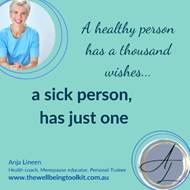
When you’re sick however, your choices are limited and sometimes curtailed completely.
You could argue that this is the most important health because it allows a person to take part in all the other healthy activities.
Long term health span
Let’s now have a closer look at building long term health, because, what you do now, every day, has an impact on long term health.
You may have heard the term “health span”. This refers to how long a person lives in a healthy state. This is different to lifespan, which is how long a person lives for. Ideally, we want health and life span to be similar. In other words, we want to live in a healthy state for as long as possible.
In Australia the gap between health span and life span can be up to 12 years*.
Take a moment to consider that. Twelve years of living in an unhealthy or diseased state.
Now think back to what you were doing twelve years ago. It’s a long time ago right? It’s also a long time to be unhealthy.
So what can we do? According to the University of NSW, this gap between health span and life span determines how people experience ageing, from the type of work they do in their 60s and 70s to what the buy, the health care they use and retirement planning.
It makes the difference between spending our later years in independence or dependence.
The Australian Bureau of Statistics states that life expectancy at birth is 81.1 years for males and 85.1 years for females.**
The health adjusted life span in 2024, for males was 71.7 years and 73.8 for females. This represents a slight 6 month increase from 2018.
So, how do we extend health span to be closer to lifespan?
Harvard Health*** recommends
- Healthy diet to support immune cells which defend against infections, protect other cells from damage and help the body to repair.
- Exercise has been shown through multiple studies, to contribute to longevity. Exercise strengthens the heart and lungs, it can improve the health of blood vessels, boost muscle strength, bone density, better balance and weight control. Physical activity also has a positive impact on mood and the quality of sleep.
- Other lifestyle factors that impact long term health include reduction in toxins such as alcohol and smoking; drinking enough water and social connections.
- A study of 28000 people**** found a link between socialising and longevity – more social interactions lead to longer life. The full study can be found in the Journal of epidemiology and community health (link below).
Take a moment to consider what your current health goals are, depending on your age and stage of life. They cast your mind forward, 5, 10, 15 or 20 years. What would you like to be able to do?
Maybe travel the world, keep working or look after grandchildren.
Whatever your goal for future-you, what current day-you is doing, will impact that outcome.
Other impacts on “health”
1 – Social impact
Social connects and networks are a key determinant in a person’s mental and emotional health. They can also impact physical health. Consider the values and principles of family, work and teachers. Maintaining relationships helps prevent depression, negative self thoughts, low self esteem and isolation.
Good social health is reliant on social connections. These are upheld through appropriate behaviour and maintaining socially accepted standards.
We can achieve good social health by communicating effectively, being accountable to others and intimacy.
2 – Mental Health
This is the state of wellbeing which allows a person to reach their potential and cope with everyday life so they can work effectively and productively thereby contributing to the community.
Good mental health directly impacts other health factors. Someone who is making progress towards a goal or recovery may feel more confident in social settings or in facing more challenging tasks or situations as well as engaging in physical activity
3 – Spiritual Wellbeing
Spiritual health not only benefits the individual but a whole community. It goes beyond religion and prayer, including the ability to live a peaceful life and acting in accordance with values.
It relates to positivity and resilience to stress. A person with a strong sense of self is more likely to have a reason to live and make good health choices.
4 – Emotional wellbeing
Emotional health is related to confidence and the ability to cope with life’s challenges. Emotional wellbeing involves managing feelings and associated behaviours, coping under pressure and being aware of emotions and stressors.
Good emotional health is linked to success at work, in relationships and health in general.
5 – Physical Health
As discussed above, physical health looks at a persons health status in its entirety and is considered the absence of disease and infection and is more than just physical fitness.
It brings together emotional, physical, spiritual and mental health. A decline in physical fitness can trigger a decline in mental health for example.
In summary, we can see that “heath / healthy” means different things to different people based on a number of factors including age, culture, life stage and economic status. There are a number of factors influencing health status which include: social, mental, spiritual, emotional and physical health.
If you’re ready to move more and get healthier, check out my timetable of classes as well as personal training and coaching options (you’ll be taken to our sister site: The Wellbeing Toolkit).
*UNSW, 4 Dec 2025
**** https://jech.bmj.com/content/77/5/277
Author: Anja Lineen, Personal Trainer and menopause educator